Sunday, July 17, 2011

The Happy Prospector

Prolific author serves up two more books on gold mining in the Pacific Northwest

By Garret Romaine

Author Tom Bohmker is no stranger to regular readers of Gold Prospectors Association of America (GPAA) magazine. We published a nice review of his book The Elusive Pocket Gold of SW Oregon, and also recommended his expanded 2005 effort entitled Gold Panner's Guide to the Black Hills of South Dakota(originally published in 1978).

Since then, he has kept up his prolific ways. In 2009 he was the contributing editor for the Gold Panner's Guide to Washington State. In 2010, Bohmker put out Gold Panner's Guide to the Oregon Cascades. As a fellow field-guide author, I eagerly seek out new publications that deal with gold prospecting in my home region of the Pacific Northwest, and I’m glad I caught up with him. I finally connected all the dots after stumbling onto the http://www.Miningbooks.com web page and ordering a book, and then hooking up at the 2011 GPAA Gold Show in Salem, Oregon.


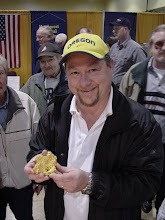
Tom and I discussed his latest books in between gold show attendees coming up with questions. People were eyeing his extensive gold collection, and playing “stump the geologist” with a wide variety of “meteor-wrongs” and leaverite samples. Every once in a while someone would produce a hunk of quartz with shiny streaks and rusty staining or a heavy, glistening sample of fascinating ore, and Tom’s day was further enriched. He easily switched between asking and answering questions, and he seemed equally happy to do either one.

Figure 1. Part of author Tom Bohmker's gold specimen collection he's collected over the years, as seen at the 2011 Salem Gold Show.

“This is a lot of fun for me,” he said from his chair, smiling. “You never know what’s coming next. Folks collect the most amazing specimens.” An accomplished mining expert, his booth was a lively spot that stood out even in that day’s exuberant atmosphere. I got the feeling immediately that Tom would be a favorite in mining camps, talking for hours over a roaring campfire about his experiences across the west.

Bohmker explained how his newest books on Oregon and Washington continue his theme of trying to be as helpful as humanly possible to the newcomers and weekend warriors. As Bohmker explained in his book about the Klamath Mountains, he’s been asked countless times some basic questions:

1. Is it possible to still go out and find some gold?

2. Where is a spot I can do some fun panning with my friends and family?

3. Are there certain types of rocks that carry the gold?

4. I just bought a new detector, so where is a good place to look for pocket gold?

5. How can I have my own claim?

His response: “Selected spots…showed potential for more extensive mining efforts. Even though some of these areas have been extensively mined since the 1849 gold rush, and were some of the areas where suction dredging was first extensively used in the 1950’s and 60’s, our conclusion was that there is still lots of “easy” gold that can be found by 'flat-lander greenhorn tourist want-to-be gold miners,' much more so by serious miners today.”

Because I had seen Tom in action at his booth, I figured he came by his geological “chops” naturally. So I asked him via email about his education and background. In junior high and again in high school, he said that he took all the earth science courses he could sign up for, and then went on to college. “I have an associate degree in aerospace technology, and a Federal Aviation Administration (FAA) mechanic’s license,” he told me. My guess is that he took at least one class on rocket science, in other words. He’s not a certified engineer (his fees would go way up if he were) but he picked up extensive coursework in geology from the College of San Mateo in California. His formal education shows in his precise use of geologically correct terms, which, being a natural teacher, he takes great pride in.

Still, Bohmker’s knowledge about western mining isn’t just based on book learnin’ and taking tests. His family background is the real foundation; both his grandfather and his father were avid prospectors. “My Dad's work selling for John Deere took me to mining areas all over the west,” he explained. “A trip with him always had some stops at active operations with his friends and customers. I was able to learn at the feet of some very talented old miners and prospectors.”

During high school and college, Bohmker and his family took all available weekends and vacations to prospect for gold, silver, and other ores. From San Francisco, they methodically fanned out, covering parts of the Mother Lode country, the Clear Lake quicksilver district, then Humboldt and Esmeralda counties in Nevada, and also the Pinto Basin and Mojave Desert areas of southern California. The expeditions roamed far into the hills, and he developed an eye for abandoned mines, old workings, tailings piles, and other signs of industry. He learned to identify what the miners were after and appreciate their ambitions.

Here’s a partial list of Bohmker’s “mining vita”:

1968 - explored and tested for cinnabar at the "No Sweat Mine"

1969 - mining technician at the Hyatt Mine in ID (lode gold)

1970 - Guadalupe Mining Company, San Jose, CA (lode gold)

1972 - Eagle Creek Mine, Birch Creek AK (placer gold)

1974-82 - leased suction dredge claims near Cave Junction, OR

1976-80 - sluiced in South Dakota

1980-81 - dredged on Illinois River, OR

1982 - dredged Klamath River, CA

1984 - dredged Middle Fork John Day, OR and Black Hills, SD

That’s only a partial list, he explained, referring to himself as a “tramp miner” after college. He’s served as a millwright, technician, foreman, surveyor, resident geologist, and more. “In 1985, I reopened the Way Up Mine for underground gold near Libby, Montana, and completed a large bulk sampling program for the owner. In the 1990's, my teenaged sons and I started leasing the Gran Turk Mine, an underground pocket mine near Columbia, California. This finally ended operation in 2008, when the 90-year old owner traded the property away.”

Even when he wasn’t mining, Bohmker was prospecting new ground or sampling fresh territory. “Whenever I traveled, I tried to do some prospecting along the way. For example, on the way to my brother’s wedding in Missouri, I took a dredge with me and dredged a day or two near Salmon, Idaho, and also near Ogden Utah. My wife claims she never realized how interested I was in mining before marriage. After we got married, we toured a variety of ghost towns from Oregon to southern California, then returned through Nevada. She can give a long, wild story about visiting a whole bunch of mining camps and smiling politely at my old miner friends as I showed off my cute new bride. That was not exactly her dream of a "Harlequin Romance Honeymoon."

Figure 2. Author Tom Bohmker has spent a fascinating career in the western mining industry.

A couple years ago, Tom faced some medical issues that put him in the hospital, weakened with Guillain-Barre Syndrome, a serious disorder where the immune system starts attacking the nervous system. While recovering, he daydreamed about his favorite dredging experiences, and kept coming back to a stint on the Illinois River in southern Oregon.

He eventually wrote the daydreaming episode up in a short story he calls “Snake Oil,” excerpted and lightly edited below:

“We were slowly uncovering bedrock on the Illinois River in southern Oregon …Finally a thin, flat boulder some 3 feet across was found “cemented” with hard pack gravels to the bedrock. I dredged around it and we hoisted the big boulders out of the hole. It took the whole morning to uncover an area 5 by 7 feet or so on the bedrock . We cleaned up about 3 DWT of flakes and pickers from this activity, found mostly in the reddish yellow pack that was within a couple feet of bedrock. We still had the cemented flat rock to move and dredge underneath. With the water clear, I hammered the cemented gravel around the edge and I could see dozens of little flakes of gold 1 to 3 mm in size swirl into the nozzle. I tried driving a gad bar (similar to a carpenter cat’s paw nail-puller) under the flat boulder to shake it loose…it seemed to be held tight with super glue. Again I circled the perimeter hammering the thin layer of cementing gravel. ...

For some 10 minutes I hammered and hammered; finally a little cloud of gray material rose around the boulder signaling it had finally loosened up. I was able to lever it off its perch and the hole became immersed in a cloud of gray. It took a long minute or two for the water to clear and I was anxiously hoping to see some gold. As soon as the dredge started to suck away the thin layer of sand and gravel I could see hundreds of flakes of gold like stars shining on a mountain night. Most of the flakes were large enough to stay on #20 mesh screen or 2 to 3 mm in size and there were hundreds of them. I recall thinking “If this keeps up we’ll get rich.” Of course the “hot spot” was over in just 5 minutes. We cleaned up the sluice again and were thrilled with over 9 DWT (nearly ½ oz. troy).

Still, he lingered in the hospital for several months, until a “golden cure” arrived when his friends brought in the perfect antidote to his doldrums – a full sample jar, crammed with placer gold. “Every day for months the doctor had come in and poked and held my feet hoping to see some nerve reaction or movement. Basically nothing in the feet had changed…they seemed to be immobile. However my mining friend Tom Quintal and his assistant “Professors of Universal Healing” wanted to try to revive my limp lower body. Although Tom was not wearing a dark cape and stove pipe hat, he did ceremoniously wave his bottle of newly mined Briggs Creek Gold under my nose. Wow, did it look good! With difficulty I was able to hold the bottle and examine the heavy flakes and small nuggets and hear them rattle in the bottle. I seemed to feel a wave of energy flow from the hands, into my abdomen then towards the feet. Gold Fever again was evident in my weak and wasted body. I was really excited and felt much better.”

Figure 3. Author Tom Bohmker inspecting a lode sample brought in at the gold show.

Future Plans

Bohmker was nearly half-done with a large work tentatively titled Gold Panner's Guide to California's Klamath Mts. before he had to slow down. He told me that he does have another work in progress: “Along with Eddie Humbird (a real good dredger and pocket hunter in John Day) we may come out with Gold Panner's Guide to Eastern Oregon soon.” It would be a quick, short work, but he still has many mining stories he hopes to get written down.


I asked Tom one of those Robert Service-type questions – was he happier working a single area continuously, or did he have the wanderlust that kept him searching? “In the past, I enjoyed just working a decent spot,” he admitted. “I spent eight years on one set of claims, including whole summers on a single, 150-foot section that was deep and rich, with plenty of good dredging spots. These were economic mining times, when the scale weight at end of the day or week was very important. However, at times I have done weeks on surveys of panning under every bridge...In 15 minutes, if I did not have good color I moved on. That was lots of fun! For example, I tried to pan every major gold stream in the Black Hills...Gold weight was not important. It was the adventure of finding color here and there.”

Field Testing the Book

I ‘test-drove’ the Oregon book immediately after leaving the show, dragging a couple helpers out to the Little North Fork of the Santiam River. We followed his directions precisely, and even though the water was still high in late March, we came home with extensive black sand and some decent colors. More importantly, we scouted out camping spots, bedrock, natural riffles, and giant cracks replenished each spring, and just where he said they were. Filing that one away for later in the summer, I immediately began planning a second trip to a spot in the Washington book, just northwest of Mt. St. Helens.

I’d been rockhounding up McCoy Creek several years earlier, searching for perfect little pyrite cubes in a wet clay in the banks of the creek. The bushwhack down was a chore, but I put the spot in my book on Washington locales. Later on, GPAA added a claim to their guide, and I was anxious to check it out on a modest, one-day trip. We waited for decent weather, and when the chance finally came, we followed his map all the way in. I knew the water would be far too high to do any decent sampling, so I concentrated on the lode mines he marked.


Figure 4. GPAA claim known as "Mother's Nightmare" is at the end of the arrow for Yellowjacket Creek, and is fed by the lode mines on Camp Creek.


Mining cabin and pyrite-laden drilling cores mark the lode mines that feed McCoy Creek.

Sure enough, I was able to locate the road in and track down the abandoned drilling cores behind the main building. I walked in further and located the caved-in mine entrance, and found further examples of extensive pyrite, chalcopyrite, bornite, and perhaps arsenopyrite. Needless to say, I went home happy. So based on meeting Tom, testing two pages from his books, and reading the republished information he provides for areas he hasn’t visited, I heartily recommend both books covered here.

Tom will be the first to admit he took more science than English in school. His publisher would do well to employ an editor, and some graphics help on the maps is also in order. But the charm of this book easily overcomes the complaints of an old writing teacher or a former geography student. Tom’s writing shines through when he relates stories about the camps, about lone prospectors who persevered or resilient men who overcame countless obstacles. His energy and enthusiasm burst from the pages, and if you’re lucky enough to be exploring a region Tom knows well, get your order in. It would be best if you could personally take Tom along, but having his book is a darned good substitute.

Garret Romaine is the author of Gem Trails of Oregon, Gem Trails of Washington, and Rockhounding Idaho. He has contributed as a columnist to GPAA Magazine for 15 years. You can find him on Facebook or email him at gromaine3@comcast.net.

Book Review: Massacred for Gold

By Garret Romaine

On a thoroughly misguided hike outside of Elk City, Idaho in 1997, trying to trace Nugget Creek to its confluence with Newsome Creek, my team ran into massive piles of timber across the trail and became, well, confused. We spent the better part of a night concerned that we were lost in the wilderness, but as the sun came up, we stumbled into signs of civilization. Walls of rocks were stacked neatly into cubicles and apartments, and it was quickly evident that we were walking through a very old Chinese gold mining camp. In another ten minutes we were in a clear-cut, and we easily followed the skid road to pavement, and then camp. Crisis averted.

Most modern prospectors are aware of the impact Chinese miners had in the last part of the 19th century. I’ve seen “China Diggins” on topo maps probably a half-dozen times, and in my field excursions, I’ve seen stacked rocks in neat piles. I’ve learned not to count on panning much more than black sand anywhere there were Chinese miners for extended periods of time, because they were patient and thorough. They had to be – they couldn’t legally own claims, so all they got were leftovers, and they faced discrimination wherever they had success.

All that serves as an introduction to a new book by R. Gregory Nokes, a former reporter for the Portland Oregonian. Nokes stumbled onto a detective story straight out of the wild west that should bring a bit of sadness to every gold prospector. His book, “Massacred For Gold,” is the story of a large company of Chinese miners who labored in the depths of Hells Canyon, where the Snake River cuts like a knife between Oregon and Washington. About 34 miners, divided into three teams, worked several coves and gravel bars along the Snake about 35 miles from the town of Imnaha, Oregon. Unfortunately, these canyons also housed a ruthless gang of horse thieves and cattle rustlers, and when the cowboys saw the Chinese miners, the temptation to rob and murder the foreigners was too much to resist.

“[the] crew uncovered a rich deposit of nuggets and heavy gold flakes along the river bank. Tucker speculated that, centuries earlier, the river had cut through a vein of gold-bearing quartz somewhere upstream and that the gold had lodged in the crevices of the bedrock where the miners found it. He didn’t say how he knew all this. But, if he was right, the Chinese scored a major strike, yielding more than the typical find of tiny particles, called flour gold. It would explain why the Chinese mined in the cove for the next eight months. However much they did find, it cost them their lives.” (p. 16)

Accounts of the actual massacre are sketchy, conflicting, and painful:

From a local newspaper account written 40 years later: “They left one to hold the horses and another as a lookout above the camp to warn of anyone coming down the river. Another was sent below the camp to warn of anyone approaching from below. Then the other three took a position on the hillside above the camp and with high-powered rifles began the slaughter of thirty-one innocent and defenseless Chinese whose only weapon of defense was 22-caliber rifle. The rifles barked and one by one the Chinamen were shot down like sheep killing dogs. They killed all but one until their ammunition ran out and when he started to flee in a boat, they had to run after him and finish him off with rocks.” (p. 40)

The bottom line was that several young white men used rifles to gun down the Chinese miners, one by one. There were signs of torture, too, as bodies began to pile up on downstream sand bars, or float past the town of Lewiston, Idaho, 65 miles away. But there was little outrage; massacres of Chinese laborers were somewhat common in the west.

Downtown Imnaha, Oregon, circa 2008. This is the nearest town to the massacre site.

Nokes does an excellent job of pulling together a story about western gold rushes, Chinese customs, and community values. Here’s his description of the town of Lewiston, Idaho, as it grew around the gold rushes nearby:

“Prior to the discovery of gold nearby, there was no such place as Lewiston. But when gold was found along the Clearwater River in 1860 and 1861 – near what is now Pierce, Idaho – it ignited an overnight gold rush, creating the need for a centrally located town to supply the thousands of miners pouring into the region….By mid-decade, however, the boom had run its course. Caucasian miners had scooped up most of the easily mined gold from claims along the Clearwater and its tributaries, then departed in droves for new and more promising gold strikes in southern Idaho…When the Chinese first arrived, the white miners viewed them as unwanted intruders. Even the possibility of Chinese competition alarmed Caucasians. To keep the gold for themselves, the miners organized whites-only mining districts. Typical was an edict from the Oro Fino mining district on April 14, 1861, which affirmed “the complete exclusion of the Chinese and Asiatic races and the South Pacific Ocean Islanders from the mines.” Similar bans were enacted by miners in nearby Warren, Nez Perce, and Salmon River mining districts.” (p. 30-31)

Without spoiling the ending, it’s common knowledge that the murder of a Chinese laborer was rarely punished. At the time, as Nokes documents, there were several similar attacks, including a riot in Wyoming and the rumored detonation of an entire mine by an owner who couldn’t afford to meet payroll for 130 Chinese miners. The most that could happen to a drunken cowboy for shooting a hapless Chinamen outside the local saloon was a $20 fine for discharging a firearm in public. One problem back then was an economic environment that turned quickly negative when the railroad construction boom petered out:

“Within a decade, however, circumstances changed dramatically. Tens of thousands of workers, both Chinese and Caucasian, were laid off during the financial panic of 1873 and the long recession that followed. What had been a labor shortage turned into a glut, and workers were thrown into a fierce and sometimes violent competition for scarce jobs. Whites were enraged that some employers preferred to hire Chinese, caring more about low wages and work habits than skin color.” (p. 35)

So, what could entice a band of foreign-born miners to travel so far from home, in a hostile land, to work so hard? Nokes explains the history of China at the time, and shows how economic conditions and the promise of rich finds was as powerful for poor Chinese laborers as it is today. Stories of fabulous wealth in California had trickled back to China since 1849, and over the course of four decades, there were enough success stories in America to continue pulling Chinese workers across the Pacific.

“The Chinese knew from their earlier experiences in California that after impatient Caucasians had mined the most accessible gold, they would be only too happy to sell their claims to the Chinese, or simply abandon them. That is indeed what happened. Once Chinese could move into the mining camps and work the old claims, they soon outnumbered Caucasians in mining towns throughout the region.” (p.31)


Rugged topography of the area near Hells Canyon features basalt flows and imposing cliffs.

By tirelessly tracking down court documents, interviewing surviving family members, locating cemetery and census records, and squinting at microfiche records from the time, Nokes pieced together not only the history of Chinese miners in the west, but also manages to explain, but not condone, how a community could harbor such murderers in its midst. He correlates the treatment of Chief Joseph’s band of Nez Perce Indians with the treatment of the Chinese, and deftly inserts himself into the story to keep it moving along. The result is an excellent book, with a kind of headlong momentum toward closure that always appears tantalizingly close, but like justice itself, never quite arrives.

I appreciated the numerous references to gold mining, buried treasure, and the history of the west. It isn’t clear to historians if the entire gold cache gleaned by the Chinese was ever completely recovered. There are all kinds of false leads, rumors, and legends surrounding what the Chinese recovered, but there are no definitive totals. Did the Chinese store all their gold in a single sack, or did each miner have his own stash? Did the robbers get a chance to split up their loot, or did the gang’s leader hide the ill-gotten gains by himself and dig it up later? Even Harland Horner’s history of Wallowa County, taken from a 1925 article of the Chieftain, which Nokes recounts, isn’t definitive:

“…Although several thousand dollars in gold dust were found by the murderers, much of the treasure was never unearthed. Each apparently had a cache of his own, and thirty hiding places are difficult to find. Twenty years after the tragedy a sheep herder found a small rusty baking powder can which had been washed out of a sand bank by the action of water. Curiosity impelled him to pick it up and he was started to find it contained gold dust. The battered can yielded more than six hundred dollars worth of dust. The little hoard had cost a life.” (p.18)

But I also appreciated the telling of a sad story, the necessary righting of a long-time wrong, and how, at long last, a public monument may come to be erected at the lonely site of the massacre. Nokes brings to life not only the misfits who committed the dirty deed, but also explores the motivations behind a luckless band of foreign miners, toiling so hard, so far from home. He exposes the community members who helped bury the truth and hide official records, and turned a murder-mystery into a detective story with ease.

It’s hard not to be angered by the entire story, and it would have been easy for Nokes to fall heavily on the side of moral outrage and advance straight to lecturing. But he repeatedly falls back on his training as an objective journalist to stay balanced. This is about as close as he comes to condemnation:

“The Chinese contribution to the development of the American West was substantial. But their efforts won them scant praise and little recognition – they didn’t fit neatly into the popular narrative of the conquest of the West by courageous white pioneers and gun-toting cowboys.” (p. 34)

In the end, it’s a tale that needed telling, and Nokes was the right man for the job.


Mining the Internet: Gold Rush Alaska

Porcupine Creek, Alaska, early 1900s (click on graphics to make them bigger and easier to view)

By Garret Romaine

Ever since the show’s debut late in 2010, I’ve done my best to carve out some TV time on Friday nights for GOLD RUSH: ALASKA on the Discovery Channel. The 10-part series follows six guys from Sandy, Oregon who cast caution to the wind and head off to Alaska to set up a full-sized, big-time gold placer operation.

It’s got to be the dream of just about every GPAA member to do what these guys did. They’ve got a really inspired setup – the oldest guy, white-haired Jack Hoffman, has run a small mine before, with his son and crew boss Todd Hoffman. The Hoffmans are bankrolling the operation, and they’ve added a solid mechanic, a safety lead, equipment operators, and assorted labor to go with a pair of big excavators, a dump truck, a front-end loader, and a full wash plant with a shaker, trommel, and jig. This isn’t me with a spiral pan out crevicing for a weekend – this is the real deal.


Figure 1. Todd Hoffman, left, supervising his father operating one of the big excavators.


Figure 2. Todd Hoffman, left, and Jack Hoffman, right, had worked a gold mine near Fairbanks in the early 1980s.

I was hooked before the first episode ended, and I’ve followed them on Facebook (http://www.facebook.com/goldrushalaska) and on the Discovery Channel at http://dsc.discovery.com/tv/gold-rush-alaska/. I even checked out the scuttlebutt at the Discovery Channel forums at http://community.discovery.com/eve/forums/a/cfrm/f/76419268601.

The team set up at Porcupine, Alaska, an abandoned town in the southern panhandle region. Anxious to learn everything I could, I checked US Geological Survey Professional Paper 610:

“The Porcupine district is ….along Porcupine Creek, a tributary of the Klehini River. Productive gravels were discovered in 1898 along Porcupine Creek and its tributaries (Wright, 1904, p. 12) The era of greatest activity was from 1900 to 1906, when about $100,000 in gold per year was produced. Between 1915 and 1917, hydraulic equipment was installed which accounted for a brief rejuvenation of the district (Eakin, 1918b, p. 99) …Total production for the district through 1959 is 53,250 ounces, all from placers.”

I found Porcupine at www.geocommunicator.gov, and pinpointed the town’s GPS coordinates: 59.420095, -136.238997. Next, I turned to www.mindat.org and got more information about Porcupine Creek (http://www.mindat.org/loc-199458.html):


Figure 3. Porcupine is the red dot on the highway west of Klukwan

“Production: The estimated total production from the Porcupine Mining Area from 1898 to 1985, including Christmas (SK062), Nugget (SK048), Porcupine (SK041), Cahoon (SK044), and McKinley (SK046) Creeks, is 79,650 troy ounces of gold. From 1898 to 1906, there were small manual operations producing as much as 9,000 troy ounces per year that were destroyed by flooding in 1906. From 1907 to 1915, mining by the Porcupine Gold Company was conducted using a flume constructed one mile below the junction with McKinley Creek. Production averaged 3,000 troy ounces of gold per year, until the flume was destroyed by a flood in 1915. From 1916 to 1918, the old flume was repaired and a new flume was built. Over 6,000 troy ounces of gold was produced during this period. The flumes were destroyed in the flood of September, 1918. Porcupine Gold Mines, which later became Alaska Sunshine Gold Mining Company, took over in 1926. In 1928, they completed a flume that originated on Porcupine Creek 0.5 miles above the junction with McKinley Creek and bridged McKinley Creek. Mining commenced in 1929 but closed at the end of the season due to poor returns. After much additional exploration, mining began again in 1935. Work continued into 1936 when the bridge over McKinley Creek was destroyed by a rock slide. As of 1986, there had been only minor, sporadic production since World War II. During times of high gold prices in the 1970's and early 1980's, some mechanized mining was conducted (Hoekzema and others, 1986).”


Figure 4. Topo map from GeoCommunicator showing the site of Porcupine, where the Hoffmans set up their mine.

Just before the final episodes ran, I tracked Todd down through his Facebook page and set up a phone interview. The Q&A transcript follows:

MTI: First off, congratulations on a great show. It’s been so compelling to watch.

TH: Thanks. We really appreciate everybody that’s watching it. We just made it into the top 25 cable shows, right below SpongeBob….(laughs)

MTI: There probably isn’t a single GPAA member who wouldn’t have traded places with you guys up there in Alaska. Tell us about the origins of this idea to start a gold mine in Alaska - was it something your dad Jack always talked about?

TH: My dad came to me when I was 15, in 1983, 1984. That was the last gold rush, gold tipped the scales at about $800 an ounce, coming out of the Carter years. So my dad came home and said we ought go gold mining. I said, that sounds awesome, but can you still do that? We made up our own plant, home-made. It had a potato digger belt – you don’t see that very often. It was kind of a neat way to wash dirt and move out the rocks. We built that, got a Case loader, got a D8 cat with a ripper, replaced the undercarriage on the Cat and put it on a train and sent it to Alaska. We mined in the 80’s for two seasons out of Fairbanks. I always knew it was something we could do. So, when gold started taking off, you know, and I’m watching what’s going on in the world, I’m thinking to myself, ‘It’s time.’ But geez, I can barely do this, maybe I can turn it into a show and get some of my fuel paid. That’s pretty much it – that’s the whole premise of what we did.

MTI: So you had done this before. You weren’t a complete novice.

TH: We didn’t do it real successfully before. We had mined, and we had gotten enough to basically break even. But some of our friends did really well. I’ve seen it happen. I knew it was possible. I’d seen things a lot of guys never get to see. And I never forgot it. Some of the best times of my life were up there. There were several mines on our creek. I actually think GPAA now owns the claim. I think it’s one of your group. And I actually know where the gold is on the claim. (Laughs) I can’t remember the name. It’s up out of Circle Hot Springs.

MTI: How did you pick Porcupine Creek? Was it someplace, or someone, you knew from your past?

TH: I went up on a fact-finding mission, and I looked at all kinds of mines. I knew that getting back into the business, plus coming up there with all the cheap equipment that I had, it was going to take me a long time to get everything running. It wouldn’t if I had a half million dollars to plunk down on a high-end system. But I didn’t –I’ m bringing a bunch of home-made stuff. So I knew we were going to have issues and stuff like that. So I had to pick an area that had a longer mining season than just the average 60-75 days. And Southeast Alaska has a season that goes almost 4 months. We started in snow and ended in snow. Plus I found this mine that I believe was pretty lucrative. It had this great history, all the way up the creek. That’s why we plunked down there. Plus, you know Schnabel there across the creek, was pretty open to having us and was really gracious with us. We actually became pretty close with him and his family, and his grandson Parker.

MTI: Tell us about the inspiration behind your wash plant – was it even an option to buy machinery already in Alaska, or did it just pencil out to make more sense by barging it all up there?

TH: Really, you don’t want to buy too much stuff already up north, because it’s pretty hammered on. It’s always better to buy down here, in the Portland-Seattle area., and then have it shipped up by barge, because you can still find a decent piece of equipment for cheap and have it shipped up there. But you get up there, it adds 20-30%, and the equipment is really beat up. They hammer stuff pretty hard up there.

MTI: Attacking that claim with a big wash plant meant it was going to take a long time to get going. Did anyone have a dredge or high-banker operating in the background? Even a sluice box would have been worth setting up just to prospect the bucket loads you were bringing up. Or were you convinced that the only way to succeed was to go big, so you didn’t even consider smaller gear?

TH: Everything was in the bigger equipment. The majority of miners are like your folks, with the high bankers and stuff like that. I believe that gold will keep climbing, and staying in that recreational capacity is going to be pretty crucial in the next few years. I really do. Because you have a minimal investment, you can move around, you can do it on your own, you don’t have the headaches of a commercial setup. But we just stuck with what we had.

MTI: Designating a safety officer was sheer genius – most of our members have watched a placer gold camp quickly pile up broken parts, used hoses, spare gold pans, and more . Your camp stayed fairly neat, and I saw spray paint on the ground, grates blocking the trammel, and safety vests everywhere. Whose idea was that to designate a leader for safety issues?

TH: Actually Thurber and Greg had safety backgrounds. Thurber is a safety officer at his construction company. He was a natural fit. Plus, you just have to have a designated safety officer. You also have to have a basic safety plan. So we did. When my daughter had her seizure, we were able to take care of her. The production crew also had a safety plan. They had repeaters, and we were able to communicate with the hospital. We took our tailings and used them to make our roads better. When we got there, it was just a mess. So we moved stuff around, all our roads were graveled, and it was pretty nice. We tried to keep it pretty decent. That’s just how we do stuff. We do the best we can.

MTI: Getting a mine going while the cameras are rolling must have been a challenge, especially since mining and “bad hair days” go together really well. Did you just adjust after awhile?

TH: Yeah, you just kind of get used to it. Almost like they’re not there. But you have to know who you are. I’m just kind of an overweight kid with a dream. So it doesn’t bother me a whole lot. When you get upset and you swear, that’s something I’m not proud of, and something I’m working on, ‘cuz you don’t want that. We know families are watching our show, and we keep that at a minimum. Of course, with television, you know they want maximum drama, but to be honest with you, we’re just trying to get our job done the best we can. It is weird having a camera on you the whole time, but after awhile you get used to it.

MTI: One of my favorite episodes was when everybody, including women and teenagers, started panning concentrates. It seemed like a lot of community spirit, everyone is in this together. Was that pretty satisfying for you, too?

TH: I was a little nervous, because when you had kids panning, you know…but my dad had showed them how to pan, and to be honest, I think I was in the wrong. Because, I was a kid, and I was panning, and that meant a lot to me, to be panning out some concentrates, that I’d be trusted to do something like that. In the end, aren’t we trying to pass on something great to our kids and our families? There’s nothing more pure than panning gold out of the ground that you’ve just dug up.

MTI: Wave tables aren’t all that complicated – I’ve seen them work. Did you ever figure out what you were doing wrong with that equipment, or was it just that there wasn’t enough gold in those early buckets of concentrates?

TH: You know, I personally don’t like them…I’ve seen better ways of doing that. But you know what? What do I know ? I’ve known guys who swear by them. But a lot of those guys have them mounted really solid in their basement. And they’ve got the material sized out really well – they’ve got the mesh sized out just right. I’m no professional – I’ve seen the extruder table that’s made by MSI Mining [http://msi-mining.com –ed] – the guy that designed that, I know him, and he is a meticulous builder, and so that extruder table is a pretty neat system. But you know, I’m like everyone else, I’m still learning. After you pull your concentrate out of your sluice box, I like to work them through a small hand jig first, to get it down to a finer concentrate. I used to actually build them when I was younger, when I was 15, 16. I sold them to the miners up in Alaska. I didn’t sell a lot of them – I think I made six of them, but they all worked really well. One of them was still going 10-15 years later, someone was still using it. That was really cool, seeing it still going.

MTI: Most of our members can only dream of digging a hole visible by earth satellite, but you guys had two excavators, pumps, and all the other equipment necessary to reach deep bedrock. In the last show I saw, there were some giant-sized boulders coming up out of the ground. Describe your efforts as you got closer and closer to the bottom of the hole.

TH: (sighs) There are other areas that are a lot easier to mine. You’re better off in an area that’s maybe 10, 15, 20 feet deep. The thing is with this one, according to what we’ve all figured out, there’s a waterfall there. And we don’t know how deep that bedrock is there. But we know there’s gold on the top, and over the years it’s sifted down to this glory hole. The problem is, like you’ve seen with Schnabel, that hole could be 100 feet deep – we don’t’ know. It’s a risk. We gauged it at 40 feet deep, so you’re really taking a risk on something like that. I wouldn’t suggest doing that. I would suggest finding a mine that has coarse gold that is not very deep – 10-15 feet to bedrock, where you can work the bedrock and follow the pay streak right up the hillside. So that’s my advice.

MTI: I pulled some of the early mining reports for Porcupine Creek, and at one point, they built a 20-foot wide flume and just put the creek in the flume, to get it out of the way basically. Did you look at those old reports?

TH: Oh, yeah. The history on that creek was incredible. The amount of gold they pulled out of there was just astronomical. And they moved the creek, a one- or two-mile flume. It was going above their head, and they’re down in the creek bed mining, dry. The problem is that the valley there has so much snow, and it can back up, and create these flash floods down through there. And it blew out this million-dollar flume they built. If you look at the old pictures it was incredible, the amount of manpower they put into that flume. We’re living on the town site. There were almost a thousand people, 500-1000 people, living at Porcupine, right there on the property. So, it has a lot of incredible history.

MTI: One thing about mining is that when you’re starting out, you learn a lot every day. A whole season is like a university degree. Plus, once you get a good case of gold fever, it’s hard to shake. Has it been announced yet if you’re going back for another summer?

TH: I am putting all my stuff together to go back. I don’t know if Discovery Channel is going to tag along again. A couple things I want to say for your members, though. A lot of the larger mines, and people up there, they don’t really want more people coming up and doing what we’re doing. They would rather that a lot of the recreational guys stay down in the lower 48. But don’t let that be a discouragement to you. Alaska is part of the US, and you have every right to put a group of guys together and do what we did. Now, having said that, it isn’t easy, and you have to do a lot of paperwork and go through the proper channels. You have to have some wherewithal to make it work. That’s what we’re trying to do is help some different groups prepare and figure out how to make that happen. That’s going to be a service I will provide in the future to help those guys go after it. Don’t get discouraged when you hear professional miners say mean things about us. Don’t worry about us. It didn’t discourage me – I don’t give a rip. The mining associations aren’t really for the little guys – they’re for the big guys. You’re not going to get a lot of help from them. GPAA has been very aggressive – you guys have done a great job working for your base. So keep up the good work.

MTI: Have you been a GPAA member in the past?

TH: You know what, I think my Dad was. For many years, I just kind of forgot about gold mining. I always looked back with fond memories, but you grow up and get married and have kids – I don’t even know where the time went. I haven’t had a lot of time to go out and do stuff like that. So, it’s kind of re-sparked the dream for my father and myself, and all these guys. Now there’s a lot of people out there watching us make mistakes, but also do some good things. They’re learning about sluice boxes, they’re learning about gold pans. There are a lot of equipment companies, like White’s Metal Detectors [http://whiteselectronics.com – ed] , that are selling a lot more stuff now. And hopefully you guys get new members, because there’s safety in numbers. I don’t care if you’re big or small, the more people involved in it, that’s how we’re going to protect the freedom to do it.

Bibliography

Eakin, H.M., 1919, The Porcupine gold placer district, Alaska: U.S. Geological Survey Bulletin 699, 29 p.

Koschmann, A.H., and Bergendahl, M.H., 1968, Principal gold producing districts of the United States: U.S. Geological Survey Professional Paper 610, 283 p.

Wright, C.W., 1904, The Porcupine placer district, Alaska: U.S. Geological Survey Bulletin 236, 35 p.


Monday, April 11, 2011

New video up: Knapping


Hanging out with the Puget Sound Knappers at their Winter Break Knap-in. What a fun group!

http://youtu.be/D_uc5pk9wpM

Those rocks are sharp!

Tuesday, March 29, 2011

Mining the Internet: ArcGIS

In this article, I want to accomplish just three things:

1) introduce you to ArcGIS, a new tool

2) update you on GeoCommunicator, an older tool that’s seen some major improvements, and

3) talk a little bit about magnets.

ArcGIS

Late last year I sat down for lunch with Evan LaCour, one of my readers. Evan is a young man with a geography degree specializing in geographic information systems (GIS). We’ve kept in touch since ever since, mostly by email through LinkedIn.com. He sent me a quick note recently about ArcGIS Explorer. It allows people to share maps, data, and tools online. There is also a desktop version available for those who don't have high speed access.

Here is the site: http://explorer.arcgis.com/. You need Microsoft Silverlight installed, which stopped me for a second. I had to reformat a laptop once thanks to a desire to use Silverlight to stream NetFlix movies to my television. It took two days to recover from that fiasco, but I’m sure there was more pilot error involved than blame for a rogue software program. Eventually, you should see the map in Figure 1:


Figure 1. Main ArcGIS screen, ready for map overlays that you select. Remember that you can click on an image to make it bigger...

Once you reach the main map, click the "map center" link in the upper left corner. It’s not intuitive, but there is a rollover if you hold the mouse over the icon long enough. I highlighted the map center link in Figure 2:


Figure 2. The Map Center button is in the far upper left corner.

The Map Center button takes you to the “Featured Maps” page. Since there’s no telling what the site managers might choose to highlight from day to day, you’ll want to learn to search the contents to find what you’re looking for. Click the blue Search bar on the left and bring up the Search screen. Type "geology" into the box and click the [Search] button. You should get a few pages of geology-themed maps to choose from.

There are topographic maps, hazard maps, mine dangers, earthquake locations, and lots more. My current favorite is the “Community Geology Base map,” which covers North America. You can zoom into your state and watch as it dynamically loads the data at different scales. Most of us have a scroll mouse now, and this will zoom in and zoom out on the data.

For example, I’ve been gearing up for a visit to the Burnt River area of eastern Oregon. The geology here is old and complicated, with Jurassic and Cretaceous granite intrusions colored pink and labeled JKg, recent Quaternary river gravels and alluvium colored yellow and labeled Qal, and so forth. I pulled out a screen shot in Figure 3.


Figure 3. ArcGIS Geology map for the Burnt River, Oregon vicinity.

One feature that will help you is the “Identify” button up in the ribbon at the top of the page. The most common need to do this would be to learn more about the color on the map, which represents a rock type, formation, or other major unit. Click this button, shown in the snip below, and you should be able to then left-click inside the map for more information.

Sometimes you’ll get a formation name, age, and rock type. Other times, you don’t get much more than the age of the rock. There are often links to the

source map, so you can chase down detailed geology from there.

I like to use a topographic map as the base, using the “Basemap” icon in the ribbon. You can go with various satellite images as well.

ArcGIS Explorer allows people who don't have a GIS or a mapping background to create and easily make, use, or view maps. You could add you own data to existing maps to create your own custom maps. You can even code your own maps that are shared on that site and combine data from multiple other maps or servers. You could plug in your GPS, use the data in GIS or other programs and add it to the web maps. In short, there’s a lot of power here.

Geocommunicator

A friend recently asked me about the Hansen Creek quartz crystals at Snoqualmie Pass in Washington state – he wanted to see if the claim activity had changed in Township 22N Range 10E Sections 15 and 22. The best tool to figure out claims is the Bureau of Land Management’s GeoCommunicator site at http://www.geocommunicator.gov/blmMap/Map.jsp?MAP=MC.

I zoomed in to Washington state and the pass area, and brought up the usual view. The maps looked more up-to-date than I remembered, and I could see claims I knew about easier. Then I clicked on the “i” button, also known as the Identify button.


Figure 4. Geocommunicator ribbon bar, showing "Identify" button.

This caused the cursor to change shape. So I clicked in the claim area, and after some throat-clearing, the following report came up in Figure 5.


Figure 5. Claim report from using "Identify" button.

All of these listed claims are closed. But the hatching indicates there are still open claims, which verified what I remembered. I ran a Mining Claims report from the upper right with the little prospector icon. I set it for Washington State and King County, and didn’t even bother with the Township and Range setting. I got the report in Figure 6.


Figure 6. Two active claims in the Hansen Creek area.

Garden Slug and Banana Slug are the two active lode claims, and have been there forever. That meant the information in my book “Gem Trails of Washington” was still accurate, which was a relief.

Magnets

On a recent outing in western Washington, we fought the urge to set up a primitive camp because of the rain. Instead, we paid for a U.S. Forest Service site at Coho Campground on Lake Wynoochee. Once we got settled and made a fire, someone pulled out one of my big, round magnets I’d recycled from a stereo speaker years ago. We tied a string on it and dragged it around, and sure enough, we soon found a bottle cap, rusty safety pin, three nails, a washer, and two screws. We also recovered enough magnetite to fill up a small eight-ounce pop bottle.

From there, the conversation went to meteorites, and for the next day, we dragged the magnet around on the various gravel bars we inspected. Sure enough, the darned thing broke on us – without recovering any heavy, rusty, or black rocks we could test for extra-terrestrial iron. We did clean up a lot of junk, however, so that was rewarding.

When I got home, I ordered up a big ringed precious-metal magnet. There are various vendors online, such as www.Magnet4less.com, www.duramag.com, www.kjMagnetics.com, and www.rare-earth-magnets.com to name just a few. These sites sell high-quality permanent magnets with ten times the strength of my old ferrite magnet, and they’re tougher, too. Hopefully they’ll arrive before my next trip and I can provide a full report.

Summary

Modern-day prospectors have great tools at their disposal, so it’s a shame not to use them. After my last column, requesting more Facebook and LinkedIn friends, I’ve received dozens of Friend requests, which has been a lot of fun. I’ve got links now to readers all over the world, and you’ve been unfailingly polite and inquisitive. I’ll try to keep sharing links and events that I discover, and I hope you’ll do the same.
[Update - since I wrote this, the GeoCommunicator site no longer provides visual claim information. I'm investigating...]


Thursday, February 24, 2011

Rockhound and Barbarian Fan


Back before I wrote so much about rockhounding, gold prospecting, and fossil collecting, I used to spin out an e-zine called "The Hyborian Review." It was dedicated to Robert E. Howard, and I had a lot of fun with it. I also learned the ins and outs of keeping up a mailing list, using Adobe Acrobat, and general Internet publishing.

Here's a link to the old PDFs:

http://www.barbariankeep.com/hyborev.html

Not sure how much longer Ed will keep that site up, but I figure I might as well link to it.

Monday, February 21, 2011

How to Carve Soapstone

By Garret Romaine and Marty Schippers

When you think lapidary, you might be put off by all the tools and technology that are required, but don’t lose hope. If you’ve ever carved a fire stick while shooting the breeze over a summer campfire, you have enough skill to work with soapstone. It’s the easiest rock and gem material to get started with, and a $10 set of files will have you fashioning amulets in no time.

In this How-To article, we’ll take it a few notches up from carving with a pocketknife – we’ll get some power tools involved. Primitive man can have his “Venus of Willendorf,” but we can do better.

Figure 1. Venus of Willendorf, a fertility fetish carved in oolitic limestone and dating to 24,000 BC.

Disclaimer

Now don’t get the wrong idea – after reading this article, you won’t be able to match famed sculptor Donal Hord of San Diego, who fashioned a young woman’s head from obsidian and created the epic “Thunder” from nephrite jade.


Figure 2. “La Cubana,” by Donal Hord. Obsidian, 1937. http://www.sandiegohistory.org/hord/images/79cubana.jpg.

Figure 3. “Thunder” by Donal Hord. From dark green nephrite jade, 20” high. 1946. http://www.sandiegohistory.org/hord/images/103thunder.jpg

Hord (1902 – 1966) worked with the hardest woods and experimented among various rocks and minerals, including granite, black diorite, obsidian, nephrite jade, and onyx. As a somewhat sickly and sheltered young man, he studied art in Mexico and developed a uniquely American style that celebrates the strength and nobility of ancient cultures. I grew so enamored with him I found a website where I could track auctions to see if his stuff ever comes up for sale: http://www.artnet.com.

Whatever your particular style, the part where art comes in is where you envision the form inside the rough material. You may not know it when you pick it up, or you may see it in a flash of light. I don’t know. This is the part I’m not so experienced in. I’m still at the crude pipes and fishies stage. That’s why I brought in Marty Schippers, an experienced carver in the Seattle area.

Safety precautions

Talc isn’t asbestos, but they hang out together. Around any metamorphic rocks you run the risk of harmful dust invading your lungs. Always use caution and ensure that you have excellent ventilation. If you are going to operate sanders, grinders, drills, and power saws, you should always use a mask, use eye protection, and maybe shin guards and a helmet, if possible.


Figure 4. Be extremely wary of getting dust in your lungs or eyes.

Mineralogy Lesson

Soapstone is a talc-rich schist, and has been fashioned for centuries into jewelry and tools. On the Mohs hardness scale, talc is a 1, and you can scratch it with your fingernail. The more talc present, the softer the stone. Wikipedia has a great write-up, explaining that soapstone occurs when tectonic plates grind against each other at great depth. The heat and the pressure, when mixed with the strange witches-brew of chemicals that circulate miles below the crust, is never quite enough to completely melt the rock, so it retains all its streaks and swirls.

Just to continue the geology lesson into mineralogy, soapstone can start out as dunite or serpentinite, but with more metamorphism, it cooks into a composition of talc, chlorite, and amphiboles, with trace to minor iron and chromium. Pyrophyllite is similar to soapstone and has similar uses.

Soapstone pipes are occasionally found among Native American artifacts, but catlinite, or pipestone, was apparently the preferred medium for fancy ceremonial purposes. As a side note, check out Pipestone National Monument at http://www.nps.gov/pipe. You have to be a member of a tribe and make reservations far in advance to dig there. So stick with soapstone!

Ten Easy Steps

Listed below are ten easy steps to follow when completing a soapstone carving project.

Step 1: Find a rock, get it home

There are multiple soapstone locales in the US, which you can track down using Mindat at http://www.mindat.org. Outside of Seattle, Washington, on the North Cascades Highway, the rivers and creeks near Marblemount contain some good soapstone material, but most of the mines are no longer active. That’s the general area where we collected from, plus another chunk from a Washington State Mineral Council (WSMC) field trip at Lake Wenatchee. If you want further information, consult the Council at their new home page: http://www.mineralcouncil.org. (In addition, a shameless plug: my book Gem Trails of Washington will help you find soapstone at Marblemount.)

Figure 5. Map of Marblemount soapstone area; click to enlarge (from Gem Trails of Washington.)

It’s possible to use a chainsaw or handsaw to remove large chunks of soapstone from an outcrop.

Step 2: Envision some kind of form

Now that you have a chunk, you need to figure out what to do with it. Marty explains, “I don’t know where it really comes from, but you just start to see something in there. I had a small boulder once that I just knew was going to be a frog, and out it came. I carved some salmon once, and it just seemed like the most natural thing to do with the piece. After a little experience, you see something and you just know you could get a small orca out of it.”

Figure 6. Envisioning the form that you are about to release is the tricky part.

Animals and figurines are more of a challenge, so you might want to start with easier projects. When carving simple shapes and abstract forms, there is more leeway in the approach. You may simply want to work with the stone and experiment. It takes practice to learn the art of the possible, so feel free to try different tools and approaches.

As Marty explains it, “Basically, you’re going from big to little. I'm sure just about anything used to shape wood or metal could be employed. A flat screw driver and a carpenter’s hammer would remove a lot of rock.”

Step 3: Cut off big chunks

This is where the dust starts to fly, so be prepared to make a mess. Your main goal is to reduce the amount of time you have to be more careful with trimming. A Saws-All with a good blade will work really well. I’ve seen rockhounds in the field bring a carpenter’s saw with them to cut out top-quality chunks of soapstone, so any saw will work. Power tools are more fun, certainly.

Figure 7. Use power tools such as a Saws-All to remove big chunks of material.

In this procedure, Marty wanted to create an interesting fountain, so he needed to taper the top and leave plenty of room for his imagination. He sawed one side basically smooth, then roughed in some beginning forms on the side for swirls and knobs.

Step 4: Rough out

Marty uses a pneumatic die grinder with rotary rasps and stones for the rough stuff. You might find that a chisel removes pieces more easily, so if you have one, consider using it. This step is optional; the photograph below is from a bowl project. Marty has a better collection of tools than I do, so I never know if he needs to use something or is just giving it a try.

The goal at this step is to have a good roughed-out form. If the piece will be sitting on a pedestal, you can get a flat bottom going. If there are arms or fingers, they should start to emerge. You should start to see your piece better at this point.

Figure 8. The air chisel can help with material that will chip away. Marty used it more on the bowl project than on his fountain, so your mileage may vary.

Step 5: Drill hole

Now that the form is roughed out and sits on a pedestal, it is ready for the fountain hole. The drill bit for this fountain project was insanely long, and required a good, straight aim, plus patience, and some luck. The fountain hole can be one of the trickiest parts to get right, because you sometimes have to drill the hole from the top AND the bottom, requiring pinpoint accuracy. Marty’s advice is to invest in the longest bit you can buy, as, the “two-hole” approach is maddening and can stop a project in its tracks.

Test the water flow of your fountain hole at this point, as the water won’t stain the raw soapstone.


Figure 9. Drilling holes for a fountain requires the right bit and a lot of patience.

Step 6. Fill cracks

Now that most of the rough stuff is over, it’s time to repair the damage. If you sloughed off a piece when drilling, or otherwise saw a crack emerge, all is not lost. Invest in a few tubes of Superglue and get a good fill on the problem areas. Let the material dry for a minimum of what the label says. Be extra patient here, or you could repeat the step.


Figure 10. Some material cracks more easily, but a strong glue will fix the problem.

Step 7: Add detail

At this point, Marty had zeroed in on the forms and shapes he wanted, including a line of grooves on the face. He roughed in the parallel lines with a mix of power tools, including a grinder, and also used a set of files with various edges and tips.

“Just about anything will work,” Marty says. “You can use a hobby rasp or file, a Dremel, some wood carving chisels, smaller fine files, or a pocket knife. Avoid the temptation to try one of your wife's best pieces of cutlery.”

Treat this step as the final work before fine sanding can start. Make sure you have taken enough material off; you don’t want to rely on sanding to remove a lot of rock at this point.


Figure 11. A grinder is good for smoothing down the rough edges quickly.


Step 8: Sanding

At this point, Marty’s form is definitely taking shape. He’s put in a series of rough, parallel grooves, added various knobs and ridges, and worked with the piece’s natural streaking from green to reddish. But the surface is still coarse, so sandpaper is the next tool.


Figure 12. Wet-sanding with a fine-grit sandpaper ensures that you don't take off too much material with each pass.

“As far as the sanding goes, I start with 80 to 120 grit dry sand. It’s pretty dusty, but that’s why they call me ‘Dusty Fingers.’ When I get to 200 grit, I start wet-sanding, which simply involves keeping the sandpaper wet while working. I keep getting finer, going all the way up to 1000 grit. On a typical project, I wet-sand at 200, 400, 600, 800, 1000, and even 1200 grit.”

By the way, the finer grit sandpaper is usually found at auto body supply stores – not at Home Depot or Lowe’s.

This is the final step where you take material off, so make sure everything is smooth and nice before proceeding.

Step 9: Polish + Seal

Soapstone will turn color with age, water, dust, or other influences, as it will oxidize and form a crust. The best you can hope for is to slow down the process. There are several different schools of thought here, but Marty reports on what worked best for him.


Figure 13. Marty uses Minwax Helmsman spar urethane to seal the sanded soapstone.

“I would recommend the urethane for a piece you plan to leave outdoors, and any water feature should have a satin or gloss finish. Indoor art would be better served with plain beeswax or "BRIWAX" brand furniture wax. Any wax could be used, but these are my preferences. The point being that fine art does not encourage a hard coating like the urethane. It needs to be as natural as possible.”

Step 10 Present

Here is the finished piece, without any tubes or pumps showing. From some angles, it resembles a horse head, while from other directions it is more abstract. Marty calls the piece “Grooved Fountain.”


Figure 14. The finished product.

Summary

There you have it – ten steps to making your own soapstone carving with various tools. If you just want to make a fetish or amulet, or some ear rings, the process is a lot simpler, and less power tools are involved. Be aware that carving soapstone can lead to working with additional materials, and you can see what experts do with material like jade. The fun part of this project for me was that we collected the material ourself. Plus you can work at your own pace and learn something new. At some point, you may even start to see salamanders creeping out of their rocky prison, and you’ll know you have achieved the rank of a master carver.