Showing posts with label metal detecting. Show all posts

Monday, February 21, 2011

Meteorites, Magnets, and Metal Detecting

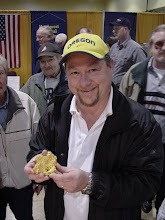
I’ve probably been watching too much “Meteorite Men” on the Science Channel. I’m starting to see little rusty rocks everywhere I go, and since I visit a lot of gravel bars in the course of rockhounding and gold prospecting, I’m getting nervous that I’ve passed over a valuable piece of space debris. If you haven’t caught meteorite fever yet, try this website: http://meteoritemen.com and check out the stories there. You can even purchase a space rock of your own, such as the Gibeon fragment from Namibia worth about $3,300, shown in Figure 1.

Figure 1. (Left) The Gibeon meteorite, from Namibia, weighs about 3,600 grams and is for sale at www.aerolite.org for $3,300.

In one of the latest episodes, the two meteorite hunters traveled to the Atacama Desert in Chile to visit a known “strewn field” where they had found fragments in the past. Many times, they use metal detectors for their work, including one time when they rigged up a giant ten-foot array detector that they towed behind them in a Kansas wheat field. They found a huge space rock about six feet beneath the soil thanks to that contraption.

This time, they rigged up a drag board fitted with dozens of powerful rare-earth magnets, and hooked it to their pickup truck. They repeatedly raked the red desert floor and managed to attract dozens of little pieces of iron, worth between $5 and $10 per gram. They also devised another big array detector and found a larger piece, worth almost $20,000.

We all know there are about 31 grams in a troy ounce, and with gold at about $1300 per ounce, that works out to around $40 per gram. Some of the very rare pallasite meteors are worth about the same amount.

Obviously, a metal detector that can search for gold and iron would be a nice purchase. More on that in a minute. My low-tech solution was to purchase a used golf putter at the local Goodwill store, and pick up a fancy round magnet at one of the many online sources, such as http://www.magnet4less.com.

Before going further, here’s something you should know – these neodymium-based magnets are much more powerful than you’re used to. At www.UnitedNuclear.com, they provide this warning:

“Neodymium magnets are very powerful, much more powerful than magnets most people are familiar with and need to be handled with proper care. The magnetic fields from these magnets can affect each other from more than 12 inches away. Please note that these magnets are fragile. Even though they are coated with a tough protective nickel plating, do not allow them to snap together with their full force or they may chip, break, and possibly send small pieces of metal flying on impact. Our magnets can easily bruise fingers and the larger ones can break finger bones and even crush hands as they attempt to connect together.”

I can attest to that, but the way. I had two rectangular neodymium magnets about two inches long, an inch wide, and a half-inch thick. They looked like fat dominoes. Or, one still does. When I was dinking around with them, they flew together with a loud “clap” and one of them busted into halves, with additional fragments flying around. One went whizzing past my ear like an angry hornet, and another carved a deep scratch in my finger, drawing blood. On that same Atacama desert episode of “Meteorite Men,” prospector Steve Arnold got his fingers pinched between two magnets and he, too, donated blood.

My New Magnet

So, here’s what I put together, as shown in the figures below:

Figure 2. (Left) Giant neodymium-based ring magnet. You can see it’s been dragged through the dust already, and has picked up some magnetite, black sand, or iron.

Figure 3. (Right) Used golf putter with various magnets attached to the head of the club, and the big ringed magnet sitting on top. Total cost was about $40.


Figure 4. Trash, black sands, and hot rocks picked up around the campfire. Nickel is for scale – magnets don’t pick up most coins.


Famed comedian W.C. Fields once observed there were two ways to travel: first-class, and with children. I sometimes feel the same way about camping. Kids are great fun, and opening up a world of science and discovery is a treat. But the way they run around without any shoes, risking a rusty nail and subsequent tetanus shot, is enough to drive me crazy. I’ve decided I can justify dragging my putter magnet around the campfire a few times because I’m sure to clean up a lot of rusty nails and other trash. I’m a one-man camp cleaner. You can see one of my hauls in Figure 4. In the more popular US Forest Service campgrounds, I’ve run a quick pass over the gravels where I park, and I’ve picked up quite a few nails from perilously close to my tires.

Here are some more links and some background information about neodymium magnets, found at www.kjmagnetics.com.

Rare Earth

“Neodymium magnets are a member of the Rare Earth magnet family and are the most powerful permanent magnets in the world. They are also referred to as NdFeB magnets, or NIB, because they are composed mainly of Neodymium (Nd), Iron (Fe) and Boron (B). They are a relatively new invention and have only recently become affordable for everyday use.

Grades of Neodymium

N35, N38, N42, N38SH...what does it all mean? Neodymium magnets are all graded by the material they are made of. As a very general rule, the higher the grade (the number following the 'N'), the stronger the magnet. The highest grade of neodymium magnet currently available is N52. Any letter following the grade refers to the temperature rating of the magnet. If there are no letters following the grade, then the magnet is standard temperature neodymium.

Platings/Coatings

Neodymium magnets are a composition of mostly Neodymium, Iron and Boron. If left exposed to the elements, the iron in the magnet will rust. To protect the magnet from corrosion and to strengthen the brittle magnet material, it is usually preferable for the magnet to be coated. There are a variety of options for coatings, but nickel is the most common and usually preferred. Our nickel plated magnets are actually triple plated with layers of nickel, copper, and nickel again. This triple coating makes our magnets much more durable than the more common single nickel plated magnets. Some other options for coating are zinc, tin, copper, epoxy, silver and gold. Our gold plated magnets are actually quadruple plated with nickel, copper, nickel and a top coating of gold.

Demagnetization

Rare Earth magnets have a high resistance to demagnetization, unlike most other types of magnets. They will not lose their magnetization around other magnets or if dropped. They will however, begin to lose strength if they are heated above their maximum operating temperature, which is 176°F (80°C) for standard N grades. They will completely lose their magnetization if heated above their Curie temperature, which is 590°F (310°C) for standard N grades. Some of our magnets are of high temperature material, which can withstand higher temperatures without losing strength.”

Neodymium Magnet Information

More background information about neodymium magnets: http://www.kjmagnetics.com/neomaginfo.asp.


Neodymium Glossary

More than you ever thought you could learn about magnetism and magnets. Here’s a full glossary with more details about magnets: http://www.kjmagnetics.com/glossary.asp

Picking a Metal Detector

Magnets are cheap and easy, but I’m planning to replace my old Minelab metal detector in the coming year. I’ve been haunting the websites of two manufacturers: White’s at http://whiteselectronics.com and Fisher at http://www.fisherlab.com.

Getting back to the Meteorite Men, they had this to say on their website about their metal detector:

“If you've watched the award-winning series Meteorite Men on Science Channel, Discovery, Quest, or one of our other networks, then you've seen Geoff and Steve using the remarkable new Fisher F75. This extraordinary, top-of-the line detector is lightweight, perfectly balanced, extremely sensitive and the Meteorite Men's hand-held detector of choice. And it's a meteorite-finding machine.

The Meteorite Men used their F75s with great success at Canada's amazing Whitecourt Crater, at Gold Basin in Arizona, at the famous Odessa, Texas meteorite crater, on the search for the legendary Tucson Ring, and at many other secret locations. If you want to up the odds of finding your own space rock, then you need to be using the best equipment out there, and that's the F75.

The Meteorite Men are delighted to offer the very same unit that they've worked with throughout Season One and Season Two. Purchase directly from us and you will receive an exclusive color photo of Steve and Geoff, along with a genuine Sikhote-Alin iron meteorite (witnessed fall, Russia, 1947), so you'll know exactly what a meteorite sounds like when your detector goes over it.”

Cost is about $1,249. That’s a little steep for most of us to justify to our Chief Budget Officer, so they advertise a “starter” GoldBug for about $550.

The White’s GMT costs about $800. I logged onto their site and got this report:

“The White's GMT is a good choice for a low-end gold detector. By using the term ‘low-end’ I don't mean cheap quality, just low price. The GMT can be purchased for about $800.00 new and $500.00 used. It does have some problems with Arizona's heavily mineralized areas but can handle them decently with effort and practice. It can find gold as small as .02 gram with my experience and of course larger pieces. The fact that the GMT is a VLF or very low frequency detector means it can discriminate iron trash very well. In fact from my experience I'd say the discrimination is 99.9% accurate on trash. The digital scale normally shows gold at 25 or lower. What I am referring to is the digital ‘scale’ called ‘Probability of Iron’….

“The real upside to this unit is if you hunt old mine dumps or tailings piles. This is where the true dual purpose of this gold detector comes into play. While the more expensive pulse induction (PI) gold detectors will outshine the GMT or any VLF for the most part in the washes and hillsides, they won't be able to match the GMT's performance in mine dumps and tailings. Not only will the GMT find more gold in old mine tailings and mine dumps it will also tell you when a target is just an old nail or piece of iron junk accurately. It is also not affected by power lines like the more expensive PI units. It is also much lighter in weight than the more expensive PI units if that is a concern for you.

“So if you are looking for an entry level gold metal detecting gold prospecting machine that will do ok hunting washes and hillsides for gold and will absolutely shine in old mine dumps and tailings the GMT might just be the ticket.” (http://whiteselectronics.com/gmt.html)

Fisher F75 Special Edition

Alaska Mining and Diving Supply is a great spot for deals, background information, well-written stories, and more. As of this writing, they had a sale going on F75 units.

http://www.akmining.com/mine/fisher_f75_metal_detector.htm

Fisher Gold Bug 2 - About $800

As stated above, this is a solid detector that works for meteorites, gold, and coins.

http://www.kellycodetectors.com/fisher/fishergold-goldbug2.htm

http://www.akmining.com/mine/fisher05.htm

Coin hunting

I ran across a nice website recently devoted to coin hunting with a metal detector.

Figure 5. This 1875 Swiss half-franc silver coin popped up in southern Illinois recently. How it got there is a mystery… Check www.coinhunting.net for more info about recent finds.

More Meteorite Links

http://www.meteoritesusa.com/meteorite-articles/wisconsin-meteorite-strewnfield-map/

Great information, and tons of links to keep you researching for days.

http://meteorites.wustl.edu/numbers_by_state.htm

Good map and graph of known discoveries in the U.S.

http://www.lpi.usra.edu/meteor/metbull.php

A solid database of discoveries.

http://www.delostooleauthor.com/meteorite_fall.html

Delos Toole’s map of Arizona discoveries.

http://www.meteoritemarket.com/

Claimed to be the oldest and best place to buy meteorites. Also has a key to determine if what you have is really a space rock: http://www.meteoritemarket.com/metid1.htm.

http://epswww.unm.edu/meteoritemuseum/index.htm

University of New Mexico meteorite museum.

http://news.discovery.com/space/meteorite-impact-crater-google.html

Recent meteor crater found with Google Earth.

http://bbs.keyhole.com/ubb/ubbthreads.php?ubb=showflat&Number=279959&site_id=1#import

Google Earth add-on showing 26,000 worldwide meteor impacts; in .kmz format.

http://www.wired.com/wiredscience/2010/08/crater-hunting/

Physicist Amelia Sparavigna of Politecnico di Torino in Italy found a 6-mile-wide crater in the Bayuda desert in Sudan using Google Maps, a free astronomical image-processing program she helped develop called AstroFracTool, and open source image-processing tool GIMP. The work appeared on ArXiv Aug. 3.

Summary

No matter what tool you’re using out there, practice and experience is a big key. Good luck!

Garret Romaine writes from Portland, Oregon.

Wednesday, February 18, 2009

Metal Detecting

Mining the Internet: Detector Treasures
By Garret Romaine


Combing through the vast backwaters of the Internet for metal detecting information is no easy task. For each tantalizing clue about lost treasure, there are pop-up surveys to evade, political news to ignore, and ads for drugs that I can’t even pronounce. But this issue, I’ve got a nice collection of links to new (and old) reports that should make every detector owner smile.

Ancient gold wreath
http://www.msnbc.msn.com/id/26455572/
Greece continues to be a source for ancient artifacts, although tomb raiders and looters are running ahead of the authorities in many places. In August 2008, an ancient gold wreath fashioned to resemble olive leaves was uncovered in northern Greece, at the ruins of ancient Aigai. The city of Aigai was the first capital of ancient Macedonia, and was the city where King Philip II — father of Alexander the Great — was assassinated.

The story goes on to note that nearby, “in a royal cemetery at Vergina, just west of Aigai, Greek archaeologists discovered a wealth of gold and silver treasure in 1977.”

Ancient coins found in Philadelphia
http://query.nytimes.com/mem/archive-free/pdf?_r=1&res=9B0CEFDD1739EF34BC4F51DFB7668389669FDE
This old article, dating to 1872, mentions a large trove of gold coins found while workers excavated a cellar. At first the young men believed the coins were brass, and they admitted throwing the coins at each other for fun. A local jeweler soon straightened them out. The coins dated to the earliest days of the Pennsylvania colony.

Roman coins in England
http://www.ancientcoinnews.com/2008/07/treasure-hunters-delight-at-discovery.html
Three treasure hunters using metal detectors located a nice cache of 1,700-year old coins in 2007. The coins date back to the reign of four emperors: Diocletianus, Maximianus, Constantius and Galerius, who ruled Britain between 296AD and 305AD. The find wasn’t just luck: “Mr Staples, 32, said he had been searching for treasure with a metal detector for more than 15 years. He said: ‘The coins were found below the surface of the ground where the land had been ploughed quite deep. We were hovering the metal detectors above the soil when it started beeping really fast to indicate there is a real hoard of metal. We found 20 coins on the first day and a similar amount the following day. Then it was a case of a couple here and there after that.”

Australian coin mystery
http://www.yowiehunters.com/index.php?option=com_content&task=view&id=229&Itemid=72
“In the first week of December 2004, two New South Wales amateur prospectors searching for gold unearthed an unidentified ancient coin amongst rocks in uninhabited forest country near a mountain ridge to the north-east of the claimed Gympie Pyramid site with a metal detector. It was found under nine inches of soil amidst old metal fragments. The Dhamurian Historical Research Society at Gympie was alerted to the amazing discovery by an E-bay auction in late January 2005. A successful negotiation with the owners resulted in the final purchase of the historic artifact so that it remained in the possession of Gympie regional researchers.”

Tons of coins found in China
http://www.coinlink.com/News/world-coins/15-tons-of-ancient-coins-discovered-in-shanxi/
“A cellar containing 1.5 tons of ancient coins, including some 2,000-year-old ones, [was] discovered by a villager in Changzi County, North China’s Shanxi Province.
The man in Qianwanhu Village discovered the cellar with some 10,000 coins, ranging from 3 cm to 1 cm in diameter, on August 23 when he was digging a channel to place pipes for tap water, said Li Lin, an official of the Changzi Center of Cultural Heritage and Tourism. The “money cellar” was 1.5 meters under the earth, with coins being piled orderly into a cuboid of 1.3 meters long, 0.65 meter wide and one meter high, Li said.
Most of the coins were made during the Northern Song Dynasty (960-1127) with the remainders made during Han Dynasty (206 BC-220 AD) and Tang Dynasty (618-907), Li said.”

Roman coins on British beach
http://www.coinlink.com/News/ancients/ancient-coins-discovered-on-beach/
“Ancient coins have been found on a beach in the Western Isles giving new clues to the far reaching influence of the Roman Empire. Archaeologists believe the pieces of copper alloy date from the middle of the 4th Century. They were found in a sand dune, but the location in the Uists has been kept secret to protect the site. Archaeologists said it was a “lucky find” as the coins were at risk of vanishing in a high tide. Just seven other Roman coins have previously been found on the isles. A Roman brooch and pieces of pottery have also been uncovered in the past.”

Roman hoard in Portugal
http://www.coinlink.com/News/ancients/archaeologists-in-portugal-net-haul-of-roman-coins/
“Archeologists in Portugal have found more than 4,500 Roman coins bundled together inside the wall of a blacksmith’s house dating from the fourth century.
Antonio Sa Coixao, who is leading excavations in Coriscada in northeastern Portugal, said Wednesday by telephone the 4,526 copper and bronze coins were inside a hollow wall and covered by dirt and tools. The coins had apparently been put in a sack which had mostly disintegrated, he said.”

Old coin found in Wales

http://www.coinlink.com/News/ancients/metal-detector-roy-unearths-the-oldest-coin-found-in-wales/
“Retired butcher Roy Page, 69, of Coedpoeth, found the detailed 2,000-year-old coin on a farm near St Asaph when he went on a search there with the Mold-based Historical Search Society. Roy handed the tiny silver coin to the Portable Antiquities Scheme, who identified it as dating from the second century BC. It is believed to have been brought over some time after the Roman invasion of Britain in 43 AD, or during earlier visits in the first century BC. Roy, who has been metal detecting for five years, said: ‘The person who held the coin was probably a Roman.’”

Roman hoard in Wales

http://www.coinlink.com/News/ancients/exceptional-roman-coins-hoard/
“Nearly 6,000 copper alloy coins were found buried in two pots in a field at Sully, Vale of Glamorgan by a local metal detector enthusiast in April. After the ruling by the Cardiff coroner, a reward is likely to be paid to the finder and landowner. It is hoped the coins will be donated to National Museum Wales, which has called the find ‘exceptional’.
Two separate hoards were found by the metal detectorist on successive days, one involving 2,366 coins and the other 3,547 coins, 3m away. The 1,700-year-old coins dated from the reigns of numerous emperors, notably Constantine I (the Great, AD 307-37), during whose time Christianity was first recognised as a state religion.”

New Roman emperor
http://news.bbc.co.uk/1/hi/england/oxfordshire/3518621.stm
“A coin that solved the mystery of a little-known Roman emperor is going on display at a new exhibition. The base silver coin, bearing the face of Emperor Domitianus, was found by Brian Malin as he combed a field in Oxfordshire with a metal detector.
Only one other such coin exists, showing the face of the man who ruled Britain for just four days, but was dismissed as a hoax. Mr Malin's coin is on exhibition at the British Museum in London. Experts say his discovery proves the earlier coin, found in France 100 years ago, was genuine and that Domitianus did exist. The coin, estimated to be worth more than £10,000, goes on display on Wednesday at the British Museum in London.”

Gold coins of usurper found
http://www.numismaster.com/ta/numis/Article.jsp?ad=article&ArticleId=4606
“The number of known gold coins of would-be Roman Emperor Carausius recently increased from 23 to 25 specimens. The two newly uncovered examples depict Carausius, who helped himself to Roman Britain as his own private fiefdom in 286 A.D.

There is excitement among museum curators, collectors and the machinery sales manager who found the two coins in a field near Ashbourne, Derbys, but the real story is the proof that once again Britain's Treasure Trove laws work, while demands in other countries that all antiquities and coins found in the ground are cultural patrimony and therefore must be turned over to the government without any reimbursement possibility to the finder simply drive the finds underground.”

Emperor Valens gold coin

http://article.wn.com/view/2008/04/15/Gold_coins_of_Emperor_Valens_found_in_Egypt/?section=BigPhoto&template=cheetah-search%2Findex.txt
“The Egyptian Supreme Council of Antiquities announced an interesting discovery. Gold coins forged by Roman Emperor Vales were unearthed at the astonishment of archaeologists; these findings represent the first of this kind in the Land of the Pyramids.
The two coins were found during excavations in the west part of St. Catherine's monastery in Sinai. The image represented on the front side of the coins is very similar to that of Valens' and specialists agreed that he is indeed. Valens ruled the Eastern Roman Empire between 364 BC and 378 BC; his reign was nothing close to peaceful. He had to black-out the revolt by Procopius, and then fight the Sassanids, but the war with the Goths meant his end. Gold coins of this type were known in Valens' time as solidii. This type was introduced by Constantine I in 309 and was used until the 10th century. Formally, a gold coin in Roman times was known as aureus.”

Islamic coin found near Oslo
http://www.aftenposten.no/english/local/article2452938.ece
“An Islamic coin from 805 AD, found on the Hurum peninsula just west of Oslo, is causing a stir among Norwegian archaeologists. The silver dirhem, minted in Iran, is one of the earliest examples of coins to turn up in the Nordic countries. Several other hordes in the area have contained similar coins, but none date back as far as this. The previous finds have been 100-150 years younger. According to Houshang Khazaei, a researcher at the University of Oslo, the coin was minted in Mohammadiyyah in Iran. The ruler at the time was Harun al-Rashid, the fifth and most famous of the Abbasid caliphs. For several hundred years dirhems were minted in countries in North Africa and the Middle East. They were used in Europe too, much like the US dollar or the euro today, and likely came to Norway with Viking traders. The dirhem contains about three grams of silver. Payment was made by weight rather than according to the denomination on the coin. Therefore many were cut in half or into quarters to make small change.”

Steamship discovered with gold coins
http://www.hunttreasure.net/rare-gold-and-silver-coins-from-sunken-steamship-examined/1079
“Rare gold coins discovered in a sunken steamship off the Louisiana coast have been put under the microscope of sorts, by coin experts. The SS New York was a 165-foot side-wheel steamship that was found under some 60 feet of water in the Gulf of Mexico.
It carried within its hull coins made in old U.S. Mints of New Orleans, Charlotte, N.C., and Dahlonega, Ga. -- mints that have not been in action for many years. David Bowers, co-chairman of New York-based Stack’s Rare Coins and coin expert, said some of the coins are in uncirculated or mint condition and could be worth $50,000 to $100,000 each.”

Unfortunately, the full text of this article is now removed.

Viking treasure trove

http://www.hunttreasure.net/viking-treasure-trove-found-on-swedish-island-of-gotland/1019
“The island province of Gotland is a part of Sweden so when torrential rain pours down and unearths a few coins, you’d expect them to be of Swedish origin.
With two old coins emerging after the downpour, archaeologist interest perked up and exploration began.
“The result? The discovery of 52 more coins. And more interesting, all but six of the coins came from other regions and countries. They weren’t Swedish. How did they get there?
“Given that the coins were dated between the late 900s to early 1000s and taking into account the history of the island, the answer… from the Vikings.
“At one time Gotland was a Viking hub of sorts. And Viking were notorious for their travels and the "acquiring and hoarding" of multiple country coinage.
“As a point of fact, Gotland has had more Viking treasure and archaeological findings than nearly anywhere in the world.”

Rogiet hoard
http://www.museumwales.ac.uk/en/1903/
In September 1998, thousands of Roman coins from the third century AD were discovered by Colin Roberts at Rogiet, Monmouthshire. This was one of the finest hoards ever recorded from Wales and were declared treasure in December 1998.
The 3,750 coins had been buried, possibly in a wooden box, around AD 295-6 (we believe this to be the date since there were no coins later than this in the box) and span a forty-year period, with twenty-two emperors represented, a sign of the political instability of the times.

Ancient coins in America
http://www2.privatei.com/~bartjean/chap11.htm
This is excerpted from a chapter called “The Coincidence of the Coins,” from the book In Plain Sight, by Gloria Farley. The write-up is about curious coin discoveries in the United States. The coins were ancient, and some were found buried so deeply that it strained imagination to think a modern collector could have lost them. “Although some of the coins presented in this chapter do not have a verifiable context, still there is enough evidence to be considered that coins were brought here anciently. It is hoped that more coins will emerge as the readers of this book become aware of what they possess. The report of coins by many authors bolsters the validity of the inscriptions, in many ancient scripts, recorded in America.”

Ancient torc discovered
http://www.telegraph.co.uk/scienceandtechnology/science/sciencenews/3484377/Metal-detector-mans-350000-Iron-Age-neckband.html
“A metal detector enthusiast discovered a 2,000-year-old golden neckband worth £350,000 while out looking for bits of Second World War aircraft. Maurice Richardson discovered the Iron Age gold and silver choker, known as a torc, in a Nottinghamshire field near his Newark home. Archaeologists believe the torc, the most expensive single treasure find since 1996, was made by the Iceni tribe, once headed by Boudica, which had its power base in present-day East Anglia.
“Four other similar torcs have been discovered, but they were all found some 100 miles away in Norfolk. Dr. Jeremy Hill, head of research at the British Museum, described the Newark torc as ‘probably the most significant find of Iron Age Celtic gold jewelry made in the last 50 years’".

Summary
Many of the websites listed here are reliable sources of good information, so you might want to bookmark some of the home pages and check back occasionally. As detectors get better and go deeper, you can expect more of these important finds to pop up in the news. If you can’t make the discovery yourself, at least you can read about it. Sometimes that’s all the motivation you need to plan your next junket into the field.